Home Aim & Objectives
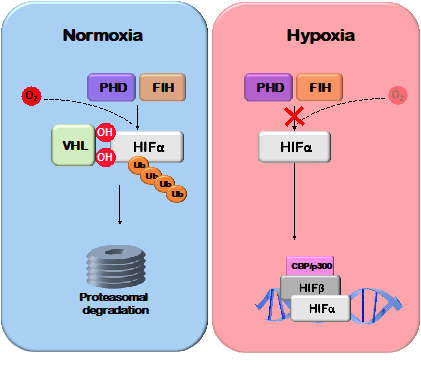
Exposure of human tissues or cells to reduced oxygen concentration (hypoxia) is a situation encountered both during physiological and pathological processes including inflammation and cancer. Every nucleated cell in human body is able to sense differences in oxygen levels and has developed molecular mechanisms in order to adapt properly under hypoxic conditions. The main regulator of the cellular adaptation to hypoxia is a family of transcription factors known as Hypoxia Inducible Factors, in abbreviation HIFs. HIFs are DNA binding proteins that act as heterodimers composed of an alpha subunit which is regulated by oxygen and a constitutively expressed beta subunit. Under physiological conditions, the alpha subunit is constantly synthesized and degraded through the proteasomal pathway. When the cells are exposed to low oxygen conditions, HIFα is stabilized following its nuclear accumulation, where it interacts with the beta subunit and then the heterodimer binds to the DNA. HIFs orchestrate a coordinated response based on changes in gene expression promoting the adaptation and survival of cells in hypoxia.
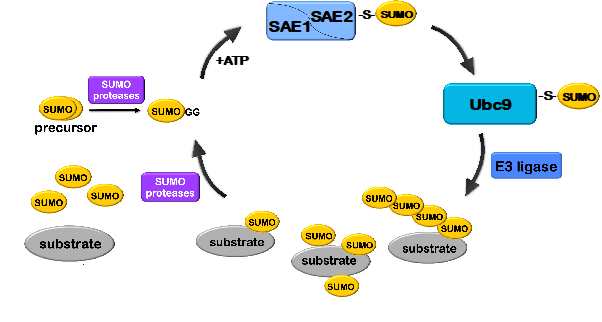
HIFs and other key proteins of the hypoxic cascade are regulated by post-translational modifications leading to the activation and regulation of the cellular adaptation mechanisms to hypoxia. SUMOylation is a reversible post-translational modification referring to the covalent attachment of the small ubiquitin-related modifier (SUMO) to a vast variety of proteins in order to modulate their function. Conjugation of SUMOs with target proteins is facilitated by SUMO-specific enzymes (E1, E2 and E3) that act resembling the enzymatic mechanism of Ubl conjugation using the energy from the ATP hydrolysis. The SUMOylation mechanism is demonstrated in the picture below:
The sumoylation pathway has been extensively studied under stress conditions and is well implicated with the cellular response mechanisms in internal and external stimuli. Lately, despite the great importance of SUMOylation in various physiological processes, a rapidly expanding field of study is focusing on investigating the involvement of SUMOylation in the response to stress conditions such as oxidative stress, heat shock and ischemia. Specifically, in hypoxia, findings show alterations in both global SUMOylation levels and SUMOylation levels of particular proteins of the hypoxic signaling cascade. As both hypoxia and SUMOylation are implicated in various pathological conditions, understanding the interrelated connections between the SUMO and the hypoxic signaling pathways and finding novel protein-protein interactions can open the way for future molecular therapeutic interventions.
Using a newly established method of endogenous SUMO-immunoprecipitation in combination with quantitative mass spectrometry (SILAC) in HeLa cells under normoxia and hypoxia, a group of proteins emerged whose SUMOylation status changed in hypoxia without concomitant change in abundance (Chachami et al, MCP 2019). The present study aims to study the involvement of novel factors and their SUMOylation as a regulatory mechanism of the cellular response to hypoxia.
The main objectives of this research are:
Objective 1. Investigation of the role of TFAP2A and its sumoylation in hypoxia concerning protein-protein interactions, binding to gene promoters that are induced under hypoxia,adaptation and response of cells.
Objective 2. Characterization of the SUMOylation mechanism of known proteins that resulted from the SILAC-IP, and investigation of their biological role in the cellular adaptation to hypoxia.
Originality of the research project
In the present research project:
- The effect of SUMOylation in protein’s function like transcription factors, transcription co-factors, RNA processing enzymes is characterized for the first time.
- The role of under-studied proteins is investigated concerning their implication in the cellular mechanism of response and adaptation of cancer cells under hypoxic conditions.
- Interactions of new proteins with the major transcription factors in hypoxia, HIFs, are extensively studied with the aim of revealing new points of regulation in the oxygen-dependent mechanism of hypoxia of target gene induction.
By revealing novel protein-protein interactions and also by finding new possible checkpoints and crossroads between SUMOylation and HIFs, we will contribute to the discovery of unknown aspects of the cellular adaptation pathway under low oxygen supply. Knowledge and further study of these new control points of the cellular response mechanism to hypoxia could pave the way for the development of new therapeutic interventions in the future.